
28 October 2026 · Nadia Dixon
Sorry About the Mess
Nadia Dixon talks to Paul Lancaster and Martin Travis about London's architecture, the reversal of their customary roles, and their forthcoming book.
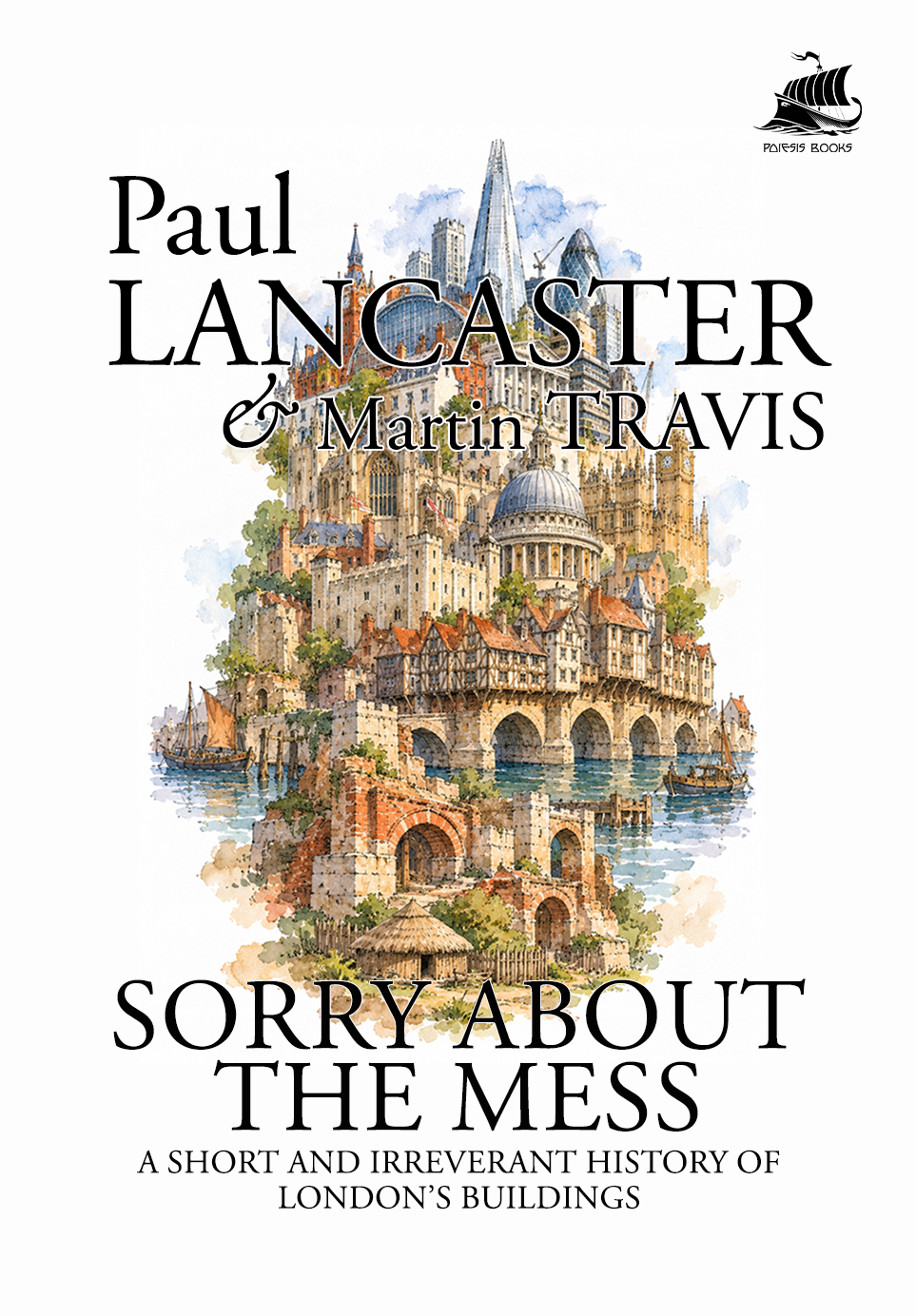 Sorry About the Mess — cover artwork by Paul Lancaster
A Short and Irreverent History of London's Buildings
A conversation with Paul Lancaster and Martin Travis
After years of illustrating Martin Travis's novels, artist Paul Lancaster has initiated a collaboration of a rather different kind. Sorry About the Mess grew out of Paul's longstanding ambition to produce an illustrated account of London's architecture, celebrating the extraordinary mixture of styles, periods and ambitions that gives the city its character. He invited Martin to contribute a series of essays exploring the historical and social circumstances behind the buildings. Nadia Dixon, publisher at Paeon Press, talks to them about the origins of the project, the reversal of their customary roles and whether London's architectural disorder is quite as charming as its admirers would have us believe.
ND: Paul, you've been illustrating Martin's novels for some years now, but this time you've brought him into a project of your own. Has this been an ambition you've been harbouring for some time, or did you simply decide that Martin needed something else to occupy him?
PL: It's something I've wanted to do for a very long time. I've always been fascinated by London's buildings, not simply as architecture but as expressions of the people and periods that produced them. London is an extraordinary mixture of styles and ambitions, often sitting rather uncomfortably alongside one another, and I've long thought it would make a wonderful subject for a series of drawings.
What I didn't want was a conventional architectural guide, with carefully rendered illustrations of important buildings accompanied by descriptions of their principal features. There are plenty of excellent books of that kind already. I wanted something more personal, more playful, a way of looking at buildings that acknowledged their eccentricities as well as their achievements.
I'd been thinking about it for years, really, without quite finding the right form. Then it occurred to me that Martin might be able to supply the missing element.
ND: Martin, I imagine being described as the missing element is rather flattering. But you're accustomed to being the author whose work Paul illustrates. Did you have any reservations about reversing the arrangement?
MT: Only the natural reservations of a writer being asked to relinquish control of something. Usually I write a book and then ask Paul to make sense of it visually, which he does with far more elegance than I have generally managed in words. This time he came to me with an idea that was already quite clearly formed.
What appealed to me was that he wasn't proposing an illustrated architectural history in the conventional sense. He wanted the buildings to have personalities, to be seen as products of human ambition, vanity, ingenuity and occasionally spectacular misjudgement. That seemed very close to the territory I've spent much of my writing life exploring, although usually the people concerned have been university administrators rather than architects.
ND: Paul, I must ask about the title. Sorry About the Mess is wonderfully apologetic, but London has been making this particular mess for two thousand years. Isn't it a little late to say sorry?
PL: Probably, but that's rather the point. London is a magnificent mess. It's the result of two thousand years of people building things, knocking them down, rebuilding them, changing their minds and occasionally discovering that what they'd put up was rather less attractive than what they'd demolished.
There has never been a single coherent plan for London, at least not one that survived very long. Every period has left its mark, often without paying much attention to what was already there. You can walk down a street and encounter several centuries of architectural history in the space of a few hundred yards, none of it apparently on speaking terms with the rest.
But I love that. The mess is part of what makes London interesting. I wanted a title that suggested affection rather than disapproval, and perhaps a little amusement at the city's expense.
MT: And it has the advantage of sounding like a rather embarrassed English host apologising for the state of his sitting room. One imagines London opening the front door and saying, 'Sorry about the mess, we've been doing a bit of building work,' without mentioning that the work has been going on since the Romans arrived.
ND: But there's a danger, isn't there, of making a virtue of everything simply because it's old and untidy? Some of London's architectural disorder is charming. Some of it is the result of greed, neglect or thoroughly bad planning. Are you in danger of being too forgiving?
MT: I hope not. Affection needn't imply approval. London has suffered from some extraordinary acts of architectural vandalism, often committed by people who sincerely believed they were improving it.
What interests me is the succession of certainties. Every generation believes it has finally understood what a great city ought to look like, and every generation leaves behind buildings which its successors regard with varying degrees of astonishment.
The book isn't intended to excuse bad architecture. But it does suggest that the distinction between good and bad is sometimes rather less permanent than those making the judgements would like to believe.
ND: So is the disorder the subject of the book, or merely the excuse for a series of amusing drawings?
PL: Both, in a way, although the book itself follows a broadly chronological course. We begin with the earliest settlements and move through the great periods of London's development. The illustrations show how successive generations imposed their own ideas of what a city ought to look like, usually without much concern for what their predecessors had intended.
I wanted the drawings to reflect that mixture of grandeur and absurdity. Some buildings are genuinely beautiful, some are eccentric, and others seem to have been designed in a moment of extraordinary confidence that subsequent generations have struggled to understand.
ND: Martin, Paul clearly had a visual conception of the book before you became involved. Did you find yourself writing to his drawings, or did you quietly begin turning it into a book of your own?
MT: I hope I resisted the latter temptation, though Paul may have a different view. He had a clear artistic conception, and my task was to find a literary voice that complemented it rather than taking it over.
I began thinking about buildings as social documents. They tell us an enormous amount about the people who commissioned them, the values they wished to display and the assumptions they made about how other people ought to live. Architecture is, in that sense, social history made inconveniently permanent.
And London is particularly rich in examples of people spending very large sums of money to demonstrate their taste, only for subsequent generations to conclude that they had very little.
ND: Paul, when you began choosing subjects, were you looking for the most important buildings or the ones most susceptible to your particular form of mischief?
PL: Ideally, both. We wanted a chronological journey, but the selection had to be visually interesting as well as historically significant. Some buildings lend themselves immediately to drawing. Others are important historically but less rewarding as subjects.
We needed a balance, and we also wanted the twenty-odd illustrations to feel like a coherent sequence rather than a collection of unrelated architectural portraits. The idea was to trace the changing appearance of London without pretending to offer a complete survey of everything worth seeing.
ND: That sounds suspiciously like allowing artistic convenience to dictate architectural history.
MT: Well, it does, to an extent, but I don't think that's necessarily a fault. In a conventional history, one might begin by deciding which buildings were indispensable and then commission illustrations of them. Here, the visual possibilities were part of the selection process from the outset.
It meant that I sometimes found myself writing about a building because Paul had seen something in it that I might otherwise have overlooked. That's a useful corrective to the writer's natural assumption that the words ought to come first.
ND: Paul, your drawings have a deliberately loose, almost mischievous quality. Why not simply draw the buildings as they are and let Martin supply the jokes?
PL: Because then the drawings wouldn't really be contributing anything beyond illustration. I wanted something in the tradition of British pen-and-ink illustration, with loose watercolour washes and plenty of white space. Not polished architectural renderings, but drawings with a personality of their own.
I've always admired illustrators who can suggest an enormous amount with very little. Ronald Searle, David Gentleman and Paul Cox, for example, demonstrate in different ways how drawing can be both economical and expressive.
The difficulty was finding the right balance between architectural recognition and caricature. A building has to remain recognisable, but if you draw it too faithfully, you can end up producing something rather dutiful. We wanted to exaggerate its distinctive characteristics, give it a little more personality, perhaps even allow it to look faintly ridiculous.
ND: But caricature is a form of criticism. Are you passing judgement on the buildings, or simply enjoying their peculiarities?
PL: A little of both. Some buildings almost caricature themselves. Others require more subtle treatment. The point isn't to make everything look absurd, but to draw attention to the qualities that make a building distinctive.
Sometimes that means exaggerating its proportions. Sometimes it means introducing figures who react to it in unexpected ways. A grand façade can look very different when there's somebody standing in front of it who appears thoroughly unimpressed.
ND: And presumably there's a point at which exaggeration becomes distortion?
PL: Certainly. Some of the early drawings were too complete, too literal, but the opposite would have been just as unsatisfactory. We gradually moved towards a looser approach, with irregular, unfinished borders so that the illustrations seem to float on the page.
We also began making the figures more important. Rather than simply putting a few people in front of a building to establish scale, we wanted them to be engaged in some small human drama.
A group of Romans in a bathhouse, for example, can tell you something about Roman life that a careful reconstruction of the building alone cannot.
MT: And occasionally something about modern life as well. One of the consolations of history is discovering that human behaviour has changed rather less than the buildings in which it takes place.
ND: Martin, your novels have a recognisable comic voice, but here you're dealing with historical fact. Does humour become a more dangerous instrument when you can't invent the evidence to support it?
MT: It certainly requires more discipline. In fiction, one invents the circumstances necessary to expose human folly. In history, the folly has generally been provided for you, sometimes on a scale that no novelist would dare propose.
The danger is that everything becomes an occasion for a joke. We wanted the book to be entertaining, but not frivolous. There are extraordinary achievements in London's architectural history, and one ought not to diminish them merely for the sake of a clever remark.
At the same time, architectural history can be rather solemn. Every change in style is sometimes presented as a profound philosophical development, when occasionally the explanation is simply that somebody had seen something fashionable in Paris and thought it might look rather well in London.
ND: I can see the attraction of puncturing architectural pomposity, but isn't there also a danger of making the architects themselves too easy a target? After all, they were often working within constraints imposed by clients, money and fashion.
MT: Quite so, and that's an important qualification. Buildings are rarely the work of a single imagination operating without interference. They emerge from negotiations between architects, patrons, builders, authorities and occasionally the people who are expected to occupy them.
The comedy often lies in those competing intentions. A palace may be intended as a demonstration of royal magnificence, but it is also somewhere people have to eat, sleep, quarrel and arrange for the drains to be emptied. The architectural historian may quite properly concentrate on the magnificence. I find myself wondering about the drains.
ND: Paul, Martin seems determined to bring everything down to the level of the drains. Do your illustrations perform a similar service?
PL: Not quite so literally, I hope. But I do like the contrast between architectural grandeur and ordinary human behaviour. A drawing can introduce humour quite gently. You don't need to turn a building into a cartoon character or surround it with elaborate jokes. Sometimes a slight exaggeration of its proportions is enough. Or a small figure looking distinctly unimpressed.
The people are particularly useful because they allow you to suggest the gap between architectural intention and everyday experience. A grand building may be designed to inspire awe, but somebody still has to sweep the steps.
I wanted the pictures to have their own little stories, things that a reader might notice on a second or third look. Ideally, the illustrations and essays should complement one another without merely repeating the same observations.
ND: You've worked together on many covers, but this seems a rather more intimate collaboration. Has the reversal of roles been entirely comfortable?
PL: It has certainly changed the sequence of things. Usually Martin provides the book, I read it, we discuss possibilities and I begin sketching. Here, the initial ideas and visual approach were mine, and Martin was working within a framework I'd already begun to establish.
That doesn't mean the process has been entirely one-directional. His essays sometimes suggested possibilities I hadn't considered, and the illustrations developed as we went along. But the central idea remained the same: this was to be an artist's view of London's buildings, accompanied by writing that shared its spirit.
ND: Martin, did you ever find yourself wanting to take charge?
MT: Naturally. Writers are not generally distinguished by their willingness to remain silent. But I found the reversal rather liberating. Writers can become accustomed to regarding illustrations as something added to their work, however important those illustrations may be. Here, I had to accept that the drawings were not subordinate to the text.
And that was quite right. Paul's project existed before I became involved. My contribution was to provide a historical and literary dimension to something he had already imagined.
Of course, I still made suggestions about the pictures, not all of which were as informed as they might have been.
PL: You have occasionally suggested that a building ought to look rather more ridiculous.
MT: Only when it seemed to me that the architect had already made a promising start.
ND: I suspect the architect might have had something to say about that. But let me put a more editorial question to you both. With more than twenty subjects covering two thousand years, how do you prevent the book from becoming either a rather thin architectural history or a rather elaborate joke?
MT: By recognising that it cannot be exhaustive. London has an long architectural history, and once one begins researching a particular building, there is always another fascinating detail demanding inclusion.
But the essays are not intended to be complete accounts. Each has to establish the historical context, explain why the building matters and offer some observations about the society that produced it. Then it has to stop.
That last requirement is particularly difficult for writers. Paul, as an illustrator, is rather better at recognising when enough has been said.
PL: I'm not sure that's always true. I can spend an unreasonable amount of time deciding whether to add three more lines to a drawing.
MT: But at least you can remove them without having to rewrite the preceding paragraph.
ND: The book ranges across periods where the surviving evidence is sometimes fragmentary. Paul, how do you reconcile artistic freedom with historical accuracy? A witty drawing can be very persuasive, even when the evidence is uncertain.
PL: That's true, and it's something we have to be careful about. You have to understand a building before you can caricature it. Otherwise, you're simply inventing something.
With surviving buildings, we have photographs, plans and the buildings themselves. With the earliest subjects, there's often much less certainty. We have to be careful not to present an imaginative reconstruction as though it were a documentary record.
But a loose drawing can be quite honest about that uncertainty. It doesn't claim the authority of a measured architectural survey. It suggests rather than insists.
ND: Martin, the same must apply to the essays. It's easy to be amusing about the past when its inhabitants aren't here to defend themselves.
MT: Indeed, and we mustn't impose modern assumptions too readily on earlier periods. It's very easy to congratulate ourselves on possessing better taste than our ancestors, although I suspect future generations will find plenty to amuse them in our own architectural achievements.
The object is to understand why buildings were constructed as they were and how attitudes towards them have changed. The humour should arise from that understanding rather than from a sense of modern superiority.
ND: Paul, are there buildings you find impossible to caricature because you admire them too much?
PL: Not impossible, but certainly more difficult. As an illustrator, I'm drawn to buildings with strong personalities. They aren't necessarily the most beautiful or historically important. Something slightly awkward, overambitious or extravagantly decorated can make a wonderful subject.
A perfectly proportioned classical façade can be quite difficult because the qualities that make it admirable also make it resistant to caricature. I enjoy buildings that appear to be making an argument. The drawing can then join in, perhaps not entirely on the building's side.
ND: Martin, you seem more interested in the arguments between buildings than in the buildings themselves.
MT: Perhaps because those arguments are so revealing. London has never been a city of consistent architectural principles, however much individual planners may have wished otherwise.
A medieval church can find itself beside a Victorian commercial building, overlooked by a twentieth-century office block whose architect was apparently determined to demonstrate that he had never seen either of them.
And yet the result is often extraordinarily successful. London possesses a remarkable capacity to absorb contradictions that would look intolerable in a more formally planned city.
ND: But that sounds almost like an excuse for bad planning. Surely there's a difference between a city enriched by historical accident and one simply damaged by careless development?
MT: Certainly, and I wouldn't want to suggest otherwise. London has suffered from both. But the difficulty is that the distinction isn't always immediately apparent. Buildings once condemned as intrusions can become indispensable parts of the cityscape, while others that were welcomed as improvements may age rather less gracefully.
The title isn't intended to suggest that everything is forgivable. It's an acknowledgement that London's character has emerged from a succession of decisions, some admirable and some disastrous, which cannot now be disentangled.
ND: Paul, would you actually want the mess tidied up?
PL: Not entirely. There are individual buildings and developments that one might happily dispense with, but the mixture itself is what makes London interesting.
A perfectly planned city can be very beautiful, but London has a different sort of appeal. Its buildings seem to have accumulated through a series of arguments conducted over centuries, with nobody ever quite winning.
And from an illustrator's point of view, that's wonderful. There's always something unexpected, something slightly out of place, something that gives a drawing its character.
ND: You've been thinking about this book for years. Now that it's taking shape, has Martin improved your original idea or complicated it?
PL: Both, probably. I always wanted a book that combined affection for London's buildings with a willingness to see their absurdities. I wanted the illustrations to be recognisable but not reverential, and to have a kind of visual wit.
What Martin has brought is a social and historical dimension that I couldn't have supplied in quite the same way. The essays explain not just what we're looking at but why it came to be there and what it tells us about the people responsible.
I think the result is richer than the book I might have produced on my own, while remaining recognisably the project I originally had in mind.
ND: Martin, do you feel you've been unusually well behaved as a collaborator?
MT: I wouldn't go quite that far. But working within somebody else's artistic conception has been a very agreeable experience. It requires a slightly different sort of discipline. Instead of beginning with a blank page and deciding where the book ought to go, I was entering a project whose character had already been established.
That doesn't mean there was no room for invention. Quite the reverse. The limitations were productive. They gave me a particular way of approaching material that might otherwise have become rather conventional.
And there is something rather pleasant about not being entirely responsible for a book's conception. If readers dislike the choice of buildings, I can refer them to Paul. If they dislike the prose, unfortunately, I shall have to answer for that myself.
ND: As the publisher, I should probably point out that readers may hold both of you responsible. But what would you actually like them to take away from Sorry About the Mess? Beyond an increased willingness to forgive architectural eccentricity, that is.
PL: I'd like them to look at familiar buildings a little differently. Perhaps notice something they've walked past a hundred times without really seeing, or discover that a building they thought rather ugly has something interesting to say for itself.
And I hope they'll enjoy the illustrations in their own right. I don't want them simply to confirm what Martin has written. They should offer another way of looking at the subject, with details that reward a second glance.
MT: I would be delighted if the book encouraged people to look upwards occasionally. London is a city in which much of the most interesting architecture exists above the level at which most people conduct their shopping.
More generally, I hope readers will recognise that buildings are not simply monuments to architectural achievement. They are records of human aspirations, compromises and miscalculations. They tell us how successive generations imagined themselves and how they wished to be seen by others.
And I hope they'll be entertained. There is no reason why learning something about the history of London should be an ordeal.
ND: One final question. After all these years of Martin commissioning illustrations from Paul, has the reversal been a success? And more importantly, who has had the last word?
PL: I think it's been a success. Although it's been rather enjoyable, for once, to be the person who decides what the book is supposed to look like.
MT: I have always assumed that Paul decided that anyway.
PL: Only after persuading you that it was your idea.
ND: Which rather suggests that nothing has changed at all. Except that this time I've had to keep an eye on both of you.
MT: An unenviable responsibility.
ND: Quite. And if the book turns out to be a mess, I shall expect an apology from each of you.
Sorry About the Mess: An Informal Guide to London's Architecture, conceived and illustrated by Paul Lancaster, with essays by Martin Travis, is a forthcoming publication from Paeon Press.