
07 August 2026 · Martin Travis
The Play's the Thing
Martin Travis on leaving the campus for the village hall, and why amateur dramatics proved a richer seam of comedy than the modern university.
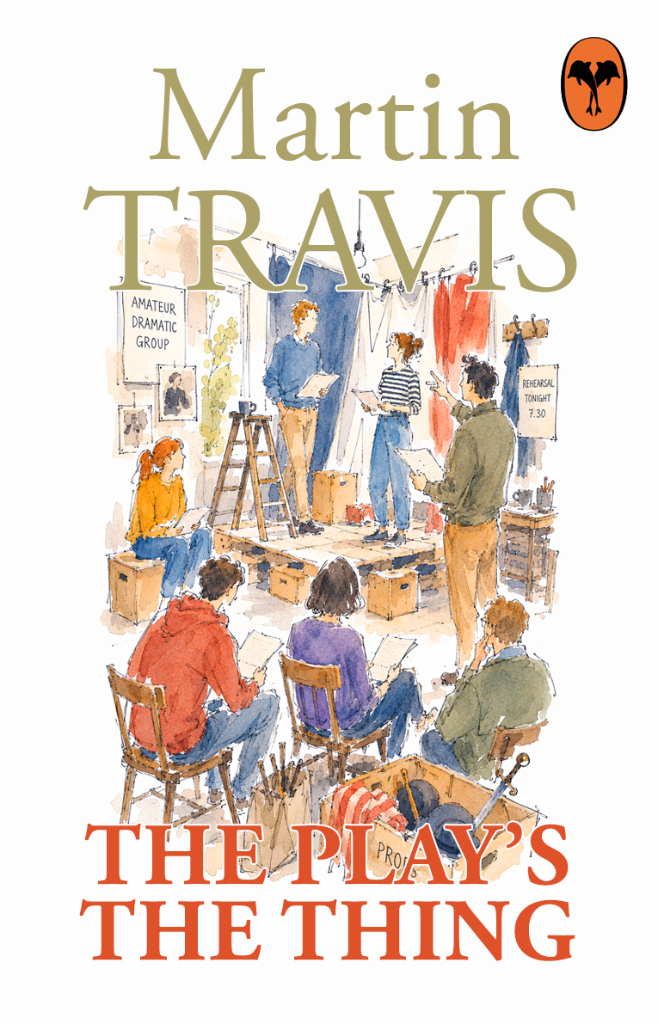 The Play's the Thing — cover
We recently invited Martin Travis to talk about his latest book The Play's the Thing, which will be published in time for Christmas. He writes:
Every novelist eventually discovers that he has been writing variations on the same book for years. Mine happened, for rather longer than I had intended, to involve universities.
That was hardly surprising. I spent much of my working life in them. They provided an inexhaustible supply of clever people behaving surprisingly foolishly, committees whose deliberations expanded in inverse proportion to their importance, and departments in which the most passionately contested questions often appeared, to outsiders at least, to possess almost no practical consequence whatever. It was a comic world because it took itself with magnificent seriousness.
Or perhaps because it had the confidence to do so.
The difficulty, from a satirist's point of view, is that satire relies upon exaggeration. It nudges reality a little beyond plausibility until the reader laughs in recognition. Increasingly, however, I found reality overtaking invention. The managerial language, the strategic visions, the endless restructurings, the proliferating acronyms, the performative solemnity of institutional life; all these became so elaborate that they resisted further comic inflation. More than once, readers congratulated me on inventing some grotesque absurdity only for a university to adopt something remarkably similar a few years later. It is a curious experience to discover that what one imagined was broad caricature has become, with the passage of time, documentary realism.
So there comes a moment when the satirist begins to suspect he is no longer following events but leading them.
Amateur dramatics offered an altogether different and happier prospect.
For many years I had toyed with writing about it, partly because I have always enjoyed the theatre and partly because amateur dramatic societies contain exactly the sort of people novelists cherish: individuals who lead entirely ordinary, even boring, lives who become, three evenings a week, romantics, despots, comedians, tragedians, carpenters, costume makers, electricians, peacemakers and, on occasion, experts in seventeenth-century French farce despite having shown no previous inclination in that direction.
There are, naturally, comic possibilities everywhere. A committee meeting deciding on the next production can possess all the diplomatic delicacy of an international peace conference. Casting a suburban comedy may expose more bruised vanity than selecting an Archbishop. The arrival of a new member is enough to unsettle hierarchies that have survived twenty years without serious disturbance. Somewhere, invariably, there is a man who believes every leading role has been written with him in mind, another who secretly wishes to direct, and someone whose principal ambition is to ensure that the interval coffee is served at precisely the correct temperature.
The temptation is to laugh at all this.
But, I think the more interesting response is to laugh with it.
What has always struck me is the extraordinary generosity upon which amateur theatre depends. After long working days, people spend evenings painting scenery, hemming costumes, shifting furniture, learning lines and worrying about audiences who may never realise quite how much effort has gone into providing them with two hours' entertainment. No one becomes rich. Few become famous. Most simply enjoy the peculiar pleasure of creating something together that will disappear almost as soon as it has existed.
There is something rather moving about that.
The Play's the Thing is therefore not a satire in the sense that my university novels were. It certainly contains comic misunderstandings, inflated egos, committee politics and the occasional theatrical catastrophe; one would scarcely be writing honestly without them. But its laughter comes from affection rather than cynicism. These are decent people making themselves gloriously vulnerable in pursuit of an enterprise that is simultaneously unnecessary and indispensable.
Perhaps that, in the end, is why I found myself leaving the campus for the village hall. Universities, admirable though they remain in many respects, have become increasingly difficult to caricature because they so often mimic the caricaturist. Amateur dramatics, by contrast, still possesses that invaluable quality upon which all enduring comedy depends: recognisably ordinary people trying, against the odds and occasionally against their better judgement, to produce something rather wonderful.
That seemed to me an excellent place to find a novel.