
24 July 2026 · Nadia Dixon
An Interview with Martin Travis
On the eve of publication of his “new” novel, The Trouble with Will.
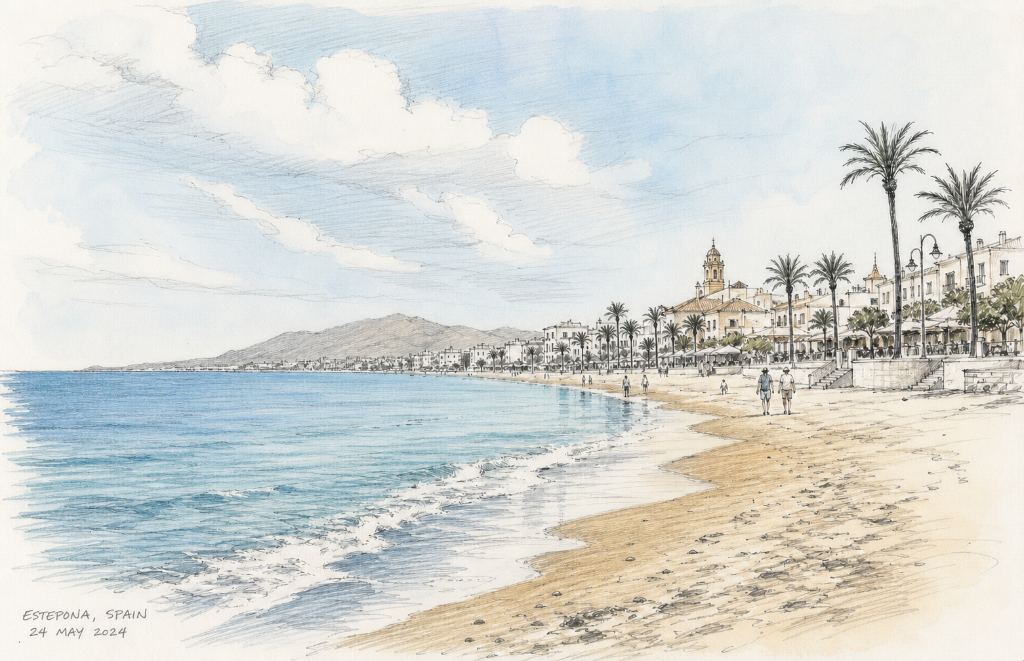 A pen, ink and watercolour sketch of the beach at Estepona, Spain — 24 May 2024.
ND: Martin, we are sitting here in your house in Spain on a hot summer's day, overlooking the clear blue waters of the Mediterranean. All this must seem very distant from the England and university world about which you have written so much.
MT: Yes, it does, though perhaps not as much as one might think. The light is certainly different—more forgiving, less inclined to expose one's inadequacies—but the habits of mind remain stubbornly northern. I still find myself peopling places like this with dons and undergraduates, as though they might at any moment emerge from behind a palm tree arguing about faculty politics. It is difficult, after a certain number of years, to stop seeing the world as if it were a slightly mismanaged college.
ND: And perhaps even more distant is your first novel, written almost fifty years ago. What was it like to return to The Trouble with Will after so long?
MT: Slightly alarming, in the way that opening an old photograph album can be alarming. One expects to encounter a stranger and instead finds a version of oneself who is both embarrassingly naïve and, occasionally, rather sharper than one remembers being. There is always the risk, of course, that early work will reveal only incompetence. I was relieved to find that it revealed something else as well—an energy, perhaps, or a willingness to be ridiculous that one tends to lose. I did laugh at some of the jokes – which I had forgotten – and also noticed that I used to swear a lot more.
ND: In your new preface, you describe it as a jeux d'esprit, more of a farce than your later novels. Do you see that as a limitation or a strength?
MT: At the time, I suspect it was both. I didn't yet have the patience—or perhaps the seriousness—to sustain anything more substantial. Farce is, in a sense, a young man's form: it allows one to move quickly, to be impertinent, to avoid the burden of too much reflection. But it also demands a certain precision, a kind of architectural discipline that I was only intermittently capable of.
Looking at it now, I think the lightness is part of its appeal. There is a freedom in not yet knowing what one ought to be doing. Later on, one becomes more careful, more aware of expectations—one's own as much as anyone else's. That can produce better books, but it can also produce slightly more inhibited ones.
ND: You also say it is the campus novel most firmly rooted in direct observation. That is interesting, given how much your later work feels so closely observed.
MT: Yes, though observation changes in nature over time. When I wrote The Trouble with Will, I was still inside the world I was describing. I was noting things almost as they happened, with very little filtration. There is a kind of immediacy to that, but also a certain lack of perspective. One doesn't yet know which details matter and which are merely decorative.
Later, writing about universities became an act of reconstruction. One selects, shapes, exaggerates. The institutions themselves also changed, of course—became less tolerant, less eccentric. In the earlier period, there was a sense that oddness might be not only permitted but quietly encouraged, provided it could be justified as part of some vaguely defined educational process.
ND: That idea comes through strongly in the preface—the notion that universities were once willing to tolerate bad behaviour if it could be framed as educational. Do you think that world has entirely disappeared?
MT: Not entirely, but it has become more discreet. In the period I was writing about, there was a kind of institutional absent-mindedness. Things were allowed to happen because no one had quite decided they ought not to. It created opportunities for both genuine intellectual exploration and fairly spectacular foolishness.
I wouldn't want to romanticise it too much. There were exclusions and complacencies that we would find difficult to defend now. But there was also a sense of possibility—a belief that the university might be a place where one could experiment not only with ideas but with ways of being. Whether that was good for the students or simply entertaining for the staff is, as I suggest in the preface, an open question.
ND: That ambiguity—who is really being educated—feels central to your work more generally.
MT: Yes, I think that is probably true. The idea that authority is slightly provisional, that those who appear to be in control are often improvising just as much as those they are supposed to be guiding—that has always interested me. In The Trouble with Will, it is handled rather broadly, as one might expect. In later novels, I hope it becomes a little more nuanced, though perhaps no less sceptical.
ND: What prompted you, after all this time, to bring the novel out of the drawer?
MT: A mixture of accident and persuasion. I had a conversation with another writer—one of those conversations that begins casually and then acquires a certain persistence in the mind. We were talking about early work, about whether it should remain buried or be allowed to surface. He suggested that such work has a kind of documentary value, if nothing else—that it records not only a stage in a writer's development but a moment in a culture.
I resisted the idea for a while. There is a natural reluctance to expose one's younger self to public scrutiny. But curiosity eventually prevailed. I reread it, expecting to confirm my earlier judgement that it was best left alone. Instead, I found myself oddly entertained. That seemed, at the very least, a reason to reconsider.
ND: Did you make many changes?
MT: Fewer than I might have expected. I corrected the more obvious infelicities—there were one or two sentences that seemed determined to collapse under their own weight—but I resisted the temptation to rewrite it wholesale. That would have defeated the purpose. If the book is to exist at all, it should exist as a record of what I was capable of at that time, not as an approximation of what I might produce now.
There is also a danger, I think, in over-polishing early work. One risks sanding away the very qualities that make it interesting—the awkwardness, the occasional excess. It is rather like restoring an old painting: at a certain point, one must decide whether one is preserving or erasing.
ND: How does it sit, in your mind, alongside the Northwick Trilogy and the novels that followed?
MT: Slightly apart, I think, which is probably as it should be. It belongs to a different phase, not only in terms of style but in terms of intention. The later books are more deliberate, more structurally considered. They are also, I hope, a little more attentive to the complexities of character.
The Trouble with Will is, by comparison, more straightforward in its pleasures. It is concerned with situation and momentum, with the mechanics of farce. That does not make it negligible, but it does place it in a different category. I would not want readers to approach it expecting a precursor to the later work in any simple sense.
ND: Do you worry about how it will be received, particularly by readers who know you through those later novels?
MT: I would be lying if I said I did not. There is always the risk that it will be judged against a standard it was never intended to meet. Readers are, understandably, inclined to assume a kind of continuity, to look for the seeds of what came later. Those seeds are there, perhaps, but they are not always easy to recognise.
At the same time, I think readers are often more generous than writers give them credit for. They are capable of adjusting their expectations, of appreciating a work on its own terms. One hopes, at least, that they might find something to enjoy in it, even if that enjoyment is of a slightly different kind.
ND: There is a line in the preface—"It was, in any case, fun, and not altogether ignoble for that." It feels almost like a defence.
MT: Yes, perhaps it is. There is a tendency, particularly in literary circles, to treat seriousness as a kind of moral virtue. One feels obliged to justify amusement, as though it were a lesser ambition. I am not entirely convinced that this is right.
Fun, if one can manage it without complete triviality, has its own value. It engages the reader, it creates a sense of shared experience. And in the context of a university novel, it seems almost essential. After all, much of what happens in such institutions is, when viewed from a certain angle, faintly absurd.
ND: Looking back, do you recognise yourself in the voice of the novel?
MT: In fragments, yes. There are moments when I think, rather ruefully, that I might still be capable of writing a sentence like that. There are others where I am relieved to feel a certain distance. The tone is perhaps a little more eager, a little less controlled than I would now prefer. But it is not entirely alien.
If anything, I am struck by the continuity of certain preoccupations—the interest in institutional life, in the small comedies of hierarchy and misunderstanding. Those concerns seem to have persisted, even as the manner of addressing them has changed.
ND: Finally, after all this time, how do you feel about the forthcoming publication?
MT: More nervous than usual, I think, which is saying something. There is always a degree of apprehension in publishing a new book, but this feels slightly different. It is not only a new book; it is an old one, carrying with it a version of myself that I no longer entirely recognise.
At the same time, there is a certain quiet hope that readers will approach it with a degree of indulgence—that they will see it not as a misstep but as a beginning, and perhaps even take some pleasure in that. Whether that hope is justified remains to be seen.